Showing posts with label Savings. Show all posts

Wednesday, 23 August 2017

9 Common Email & Social Media Scams


We’ve all heard about the Nigerian Prince who needs to transfer money out of the country and has selected us to send it to. Haven’t we? Phone and internet scams are all around us, in fact, they're so common that the ACCC recorded more than 105,000 scams a year, which resulted in losses of more than $84 million. That's only the ones that were reported: many more went unreported, often because the victim was too embarrassed to do so.

So to help you be on the lookout for, and hopefully avoid falling into their blackening pit of online deceit, we've put together a list of 10 most common scams.

1. The Urgent Transfer

What it looks like: You receive an email from a friend, family member or senior staff member telling you they need urgent access to funds. The story adds up (they're probably overseas and short on time). Besides, it comes from their email address and looks authentic. 

What's really happening: Their email account has been compromised and you're transferring your money straight into the scammer's bank account.

What can you do to avoid it: Do not reply to that email. Create a new email to that friend and ask them if they are ok, or if you can, privately message them on social media to confirm their status.

2. The Mail That Never Came

What it looks like: That credit card you applied for never seemed to arrive.

What's really happening: Scammers accessed your letterbox and intercepted the card before you had a chance to receive it. They've changed the PIN and are now using it for themselves. In the process, they're racking up a significant debt in your name. And its not just your credit card mail they will take.

What can you do to avoid it: Put a lock on your letterbox, or use a PO Box, or at least check your mailbox regularly.

3. The Parcel Pickup

What it looks like: A postal delivery company sends you an email telling you that you have a parcel that can't be delivered. If you can't collect it within 7 days it will be destroyed. But first, you need to print off a label to redeem your package.

What's really happening: Rather than printing a label, you're actually downloading dangerous ransomware. Once it's installed, scammers can use it to lock files and even destroy them. The only way you can take back control is to pay them. Making sure your computer is regularly backed up can also help counter-effect the impact of ransomware.

What can you do to avoid it: This one is really scary as all you can do to get back control of your computer, and files, is to pay them. Think before you click on anything you aren’t sure of: Are you expecting a parcel? Why would it not have been delivered? Pick up the phone and call before clicking.

4. The Tax Refund

What it looks like: You receive an email from a government agency advising you of a tax refund. To receive it, all you need to do is follow the link to your bank and enter your account details.

What's really happening: The link takes you to a fake site set up by the scammers. Instead of giving your account details – and internet banking password – to your bank, you're actually delivering this vital information straight into the scammer's hands.

What can you do to avoid it: Unless you are instigating a transfer, never put your bank account details into any site you are not sure of.

5. The 'Free' WiFi

What it looks like: You're at the airport or hotel and need to connect your laptop or mobile to the internet. When you search for a connection, you're in luck. There's a free hotspot right nearby.

What's really happening: You've actually just connected to a fake network. This allows a scammer to intercept all network traffic and steal your personal information. And the pain doesn't stop there. From now on, every time you turn on your device, you could be transmitting the same 'free' wifi to other unsuspecting users.

What can you do to avoid it: You should only connect to wifi that you know is legitimate and, if in doubt, pay to access a secure network. You should also make sure your anti-virus software is up to date and your firewall is turned on.

6. The Unrealistic Job Offer

What it looks like: You respond to an advertisement that promises you'll earn good money from the comfort of your home as an 'accounts processor'. All you need to do is set up a bank account and forward any money that comes into it, onto another account. You even get a cut of each transaction for your troubles. 

What's really happening: You're being used by fraudsters as a “money mule”: an everyday person with no criminal history through whose bank account they'll move the proceeds of crime.

What can you do to avoid it: This is money laundering, done by organized crime, and you can be implicated and go to jail. Easy money doesn’t exist. Check, research, and qualify before you go the easy route.

7. The Speeding Fine

What it looks like:  A government body/law enforcement agency, emails you to tell you that your vehicle has been caught speeding. You need to download the photo they've taken to confirm you were driving.

What's really happening: The link you click on downloads ransomware to your computer. You'll have to pay the scammers to get back the files they encrypt.

What can you do to avoid it: Same as #3, this is hard to back out of and will end up costing you a lot of money. Do your research before you click on things you are not sure of.

8. The Computer Problem

What it looks like: You receive a call from your internet service provider. They've detected a virus on your computer and it's sending error messages. The good news is that they can fix it, so long as you give them remote access.

What's really happening:  You've handed control of your computer to a scammer. They'll probably try to steal your personal data or hold your computer to ransom until you pay.

What can you do to avoid it: Never hand over remote access to anyone! If it’s that bad, take it to the service providers storefront and ask them about it.

9. The Store Voucher

What it looks like:  A well-known brand uses its social media account to post that it's giving away gift vouchers or free flights or another very attractive perk. To claim your prize, all you need to do is like the post. Like this photo, or share it if it tugs on your heartstrings, or type Amen then share, or type the solution then like.

What's really happening: You've fallen victim to a 'like farming' scam. The page isn't authentic but has been set up by a scammer who's trying to get as many likes as possible. They'll on-sell these likes - and your profile - to other fraudsters, who will start pushing spam posts in an effort to get hold of your credit card data.

What can you do to avoid it: Oh this is so common! If it’s not a friends post or a known source, stay away, don’t get sucked in by emotions or because you think you are clever enough to know the answer.

AND THAT”S JUST THE BEGINNING . . .

As the world becomes alert to the prevalence of scams, scammers are responding by becoming more creative. So, as these 9 scams start to become less effective, it's likely that newer and more sophisticated ones will take their place.

RULE OF THUMB

Email: Don’t open or download any links or attachments that you are unsure of. Research them prior to doing so. Get on the phone and check the source. Some emails may seem to come from a reputable name YourFriend, but when you click on that from name, you will find the real source: YourFriend <dodgysource@evendodgiercompany.com>

Social Media: Only respond to known posts – friends and businesses that are familiar to you.

This list was prepared by Your Money Sense where you can find out what your emotional attachment to money is and how to overcome and manage it. (We all have an emotional attachment to money)


Wednesday, 16 August 2017

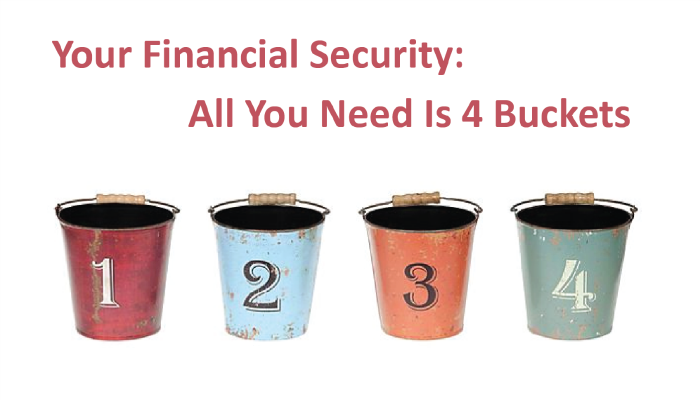
Financial Security? All You Need Is 4 Buckets

If you want to build or maintain a healthy financial life, budgeting should be your fundamental starting point. After all, how can you tell you’re on track if you don’t know where your hard-earned pay-cheque is going?

Some of us, correction: most of us, will find it daunting to maintain a budget. Getting all your expenses together, tracking what should be paid and when, how much you have left for entertainment, saving for long-term goals – it’s enough to make you give up before you start. But what if there was an easier way to manage your cash-flow that didn’t require hours of sifting through receipts or crunching numbers?

There is and it’s not that hard to get started. It starts with categorising your monthly spending into four buckets:

BUCKET ONE Fixed costs. These are bills that don’t fluctuate much and remain pretty constant each week or month, or whatever period they are relevant to: things like rent or mortgage, a phone bill or your car payment. It also includes essential costs that may vary slightly from month to month, like utility bills such as electricity or water. Although they may vary slightly, you can work out an average for the purpose of this budget. But generally speaking, if you can predict how much an expense will be, it belongs in this category.
BUCKET TWO Financial goals.These include any sort of savings or debt goal you’re trying to work towards every month, whether that’s paying off credit card balances, paying down your student loans, saving for a home or paying into an emergency fund regularly, or topping up your Super on a regular basis.

~ Take the FREE Money Personality Quiz to determine your emotional attachment to money ~

BUCKET THREE Non-monthly expenses.Got a bill that you have to pay at some point every year, but just not every month? This could include your home or car insurance or for that matter, most annual insurances, car registration fees, annual health payments, and even school tuition belongs in this category. Add up what those types of costs total to each year, then divide that total by 12. That should be what you’re setting aside each month to cover those expenses when they come up.

BUCKET FOUR Flexible spending.This category covers all those everyday costs that fluctuate each month. This can include groceries, restaurants, shopping, movies, petrol and pretty much any expense that may vary month to month.

So now that you’ve categorized your costs, how much can you actually flexibly spend each month without blowing your budget? Well, that’s a relatively easy calculation. What is your monthly take-home pay? From that, subtract your total fixed costs, and your financial goal contributions, and those non-monthly expenses you calculated. The amount that’s left over is what’s available to cover your flexible spending – the daily coffees, new shoes, magazines, etc.

If you want to know what your flexible spending is per week just divide your monthly figure by 4.3, and you’ll have your weekly spending number to stick to. So if you work out the above, and stick to it, you won’t be in danger of spending more than you earn.


If you can put your hands on the numbers from your bills, it’s not that hard to work out. And if you can work to a budget each week or month, you’ll certainly be on your way to building a financially secure future. 

If you want some more great advice about securing your financial future start by finding out your emotional attachment to money and how to overcome and manage it by taking the Free Your Money Personality Quiz.

Wednesday, 12 October 2016

When is Too Early to Start Christmas Shopping?


Are you ready to start Christmas shopping yet? Is it too early? Are you emotionally ready yet? Can you imagine buying whatever you want: An iWatch, or even a new iPhone, that handbag you keep eyeing off as you walk past the store, a new jacket, or the latest sports shoes. Put it on your credit card, or split it over two credit cards, then it won’t seem as bad when you look at the statement.

We’ve all done it and it feels good. Coming home with bags of goodies, trying them on in secret, then when quizzed weeks later “When did you get that?” you retort “This old thing”.

Haha, they’ll never know. Surely you’ve heard the old saying that “You live up to your income”, as your pay-cheque or income rises, so does your lifestyle. There’s nothing wrong with living well.

But, and there is always a But… that one-off spending spree is very rarely a “one-off”. It is addictive and gets the pleasure endorphins pumping. “Why not do it again, next week, it was fun and there’s still credit available on the card” And on top of all that the airlines are giving you reward points! Why wouldn’t you use your card?

Did you know that Australians owe approximately $33 billion in credit card debt. Here’s an easier number: Thirty-Three Billion Dollars. Personal debt per credit card holder is $4301.00 with an average of $723.45 in interest per annum. Yikes!

For many of us refusing to use a credit card is simply not an option. Without one it’s difficult to pay bills and even make reccurring payments. So use it for that and not for shopping. What should you use for shopping and spending I hear you murmur sarcastically, Use a debit card. You can’t spend more than you have in the bank that way. You’ll find you will spend less and when you next look at your bank statement you’ll even question what you are buying and maybe start to budget.

While you’re at it, have a look at your monthly credit card statement. It shows how long it will take you to pay off your balance and how much interest you’ll pay if you only pay the minimum each month. (The short answers are “forever” and “heaps.”)

So overspending once in awhile is good for you; hopefully it shows you how addictive it can be and gets you to review the financial consequences of that binge. Although a “once-off” may not impact you that much now, think about those endorphins that are working to create a monster, and there’s nothing more destructive than a spending monster. What about all that money you are spending on short term pleasure, and could be using toward the car, or house, renovation, holiday: the big ticket items that need saving for. Shame as those would be long term memories, not just a day of short term pleasure, even if it is in the name of Christmas.

What can you do to resist the “spending-money-I-just-don’t-have” urge?

Firstly use your debit card more than your credit card. Secondly put a simple budget in place, and then you’ll know what you have to spend, and what you don’t. We like to call a budget ‘Your Spending Plan’ as that is what we are all working around: Spending.

Here’s a helpful downloadable guide to control your spending and build your savings. 6-steps to Financial Security, a Free e-book from Your Money Sense. It’s a good starting point to get you in the right mindset to manage your money.

So next time you go for a bender at the shopping centre, take a few deep breaths before walking in, and think about the long term financial goal.


Tuesday, 27 September 2016

Is your child going to be driving soon?


The older you get the more inflexible you become, not willing, or able, to change our ways and habits. So for that reason alone we need to set good habits in place for the younger generation – good financial habits.

Not to say they will become the next governor of the treasury, or an actuary, or even accountant, but they will take good money habits into their lives and be able to manage their expenses. Imagine if you had that money training at school or from your parents, where you learned to save, save regularly not just every now and then; if you learned money sense. Saving for a house, or holiday or kids education would be really easy, second nature.

So we as parents have the opportunity to create this innate money comfort for our kids. We can train them to be comfortable with money, knowing that with the right mechanisms in place they won’t struggle through life and will be able to set and achieve goals.

We need to take this action now, whilst they are in high school, at 12, 13, 14, even later at 17 and 18 if you’ve left your run later. It is our job to teach them about money and how to manage it. One of the best ways to help a teenager learn about saving money is to give them an incentive to save it. One of the biggest items that a teenager craves is buying that first car. It’s more than wanting a sweet looking car, it’s about freedom. Parents go nuts thinking about the freedom it gives that teenager, and teenagers salivate over the thought of that freedom. You can use the purchase of a car as a learning tool by setting up a savings program for it.

At the age of 12, sit your teenager down and begin to explain to them that they may not be fantasising about owning a car right now, but they will most likely be thinking about it in a few years. Here are a few programs that may work with your teenager to help them save for their first car and teach a lesson about saving money and build quality personal finance habits.
1.       Sit down with your teenager, and put together a 3 to 4 year savings plan. First, set a goal of how much they want to save to buy a car with cash. NO FINANCING! Their first car doesn’t need to be a NEW car! List several activities that the teen can perform for extra money. These would include chores out of the ordinary. Clearly define which chores are done because they are a part of the family and which chores will receive compensation upon completion. Draw up a hypothetical situation where if they do 2 of these chores for the next 3 years, then they will have X amount of dollars saved towards their first car.

2.       Think about matching the amount that the teen saves to put towards a car. This adds the factor of incentive into the equation. Tell your teen that you will match their savings dollar for dollar, but only towards the purchase of a car. If they save $2,000, then they can buy a $4,000 car. If they save $10,000, then they will buy a $20,000 car. I would put a limit on this, because you never know, you may have a very entrepreneurial teen that ends up saving $20,000 over a 4 year period! You probably don’t want to be stuck shelling out 20 grand AND allowing them to drive around a $40,000 car. What this program does is gives the teen something to work for, and this is not something out of reality. Your teen will find creative ways to save, and they will be motivated to save knowing that they can have double the car if they save more than expected.

There are many other ways to help teach a teen the value of saving money. Make sure they are always putting aside a certain percentage of their saved money towards giving to others. It doesn’t have to be a lot, just something to get the message home. If you teach them the value of giving at a young age, they will grow up to be generous and kind citizens in the future. Greed kills marriages, friendships, and destroys careers.

A good start to understanding the money saving habit process is by downloading our Free Your Money Sense e-Book: “6-steps to Financial Security”.

Tuesday, 30 August 2016

If you change this habit you’ll quickly improve your financial situation?


Change your habit; the habit of spending. Firstly you need to learn how to save on small things. Saving, spending, they go hand in hand. This is probably the fastest and easiest way to improve your financial situation. We’re not always fully aware about the money we spend on certain daily habits. Habits are a very strange thing. They just happen time and time again, and generally subconsciously.  
If you put a value on each time you ‘do’ a habit it ends up costing a small fortune. If you go to the same coffee shop day in and day out: that’s a habit. Drinking coffee in a local coffee shop on a daily basis drains your monthly budget. How can you break that habit? Well that’s not for us to say, but we’ll give it a go anyway. We know you need your coffee, but just consider how it gets into the cup. Maybe pick up a home coffee machine, or get one at work, they really do produce great coffee these days and cost cents on the dollar. Try taking a bottle of water with you so you might sip on that rather than get a coffee for the sake of it.
How much electric energy or water are you using each day? It’s not one of those free resources that are just there like air, it costs money. If the weather outside is not very hot, you don’t need to use the air conditioning and vice versa, if it is not very cold you can turn off or set the heating at a lower temperature. If no one is watching TV or if no one is working on the computer, turn them off, or power them down. Make sure that the taps are turned to the end and don’t let the water run unnecessarily. Have a 10 minute shower instead of a 30 minute shower. It all costs money and if you adjust the way you do or use these things, they’ll end up saving you money.
This has nothing to do with skimping – it’s just a case of thinking what it is costing you unnecessarily, and then adjust your habit. By cutting down on some of those habits, you’ll have reasonable savings by the end of a few months.
No-one is saying “don’t do that anymore” but if you’re honest with yourself you know there are many, many, more “habits” that you could adjust. A slight adjustment will save you a lot of money over the course of a month.
So do you know what the fastest way to improve your financial situation is yet? Habit: Change: Adjustment: Realigning; any of those will cover it.
What habit do you need to change?

A good start to understanding the habit change process is by downloading our Free Your Money Sense e-Book: “6-steps to Financial Security”.

Wednesday, 24 August 2016


The Association of Financial Advisers (AFA) and TAL have announced the semi-finalists in the 2016 AFA Female Excellence in Advice Award.

Developed in 2011 as a joint initiative by the AFA and TAL, the Award recognises and showcases the talents and contributions of women in financial advice to their clients, community and profession. The Award criteria includes assessment of the candidates’ contributions to financial literacy in the community and/or campaigns targeted specifically at helping female clients take control of their financial lives.
AFA CEO, Brad Fox, said the Award is a reflection of the AFA’s commitment to continue to generate and encourage positive change in the financial advice sector, with women constantly being encouraged to enter the advice profession.
“The AFA is immensely proud of this Award, the calibre of entrants it attracts, and ultimately the finalists and in particular the winner. Our profession is going through significant change, and to see more women advisers coming through providing great advice to Australians is very important from a diversity perspective.”

When asked about her business and contribution to the financial services industry, Karen Vickers proudly explained, “My primary business is ARC Wealth, a financial advisory service to an established core of clients. From the strength and security of ARC Wealth I am building an online platform, Your Wealth Vault, which educates and guides people through a series of educational courses called Your Money Sense. These courses are aimed at guiding individuals to take ownership of their financial security, through courses of basic understanding of their money and then onto more sophisticated courses guiding them to their own financial management and wealth building.”

Your Wealth Vault courses are designed to help Australians understand how their money works and what they can put in place to manage their finances whether that is for day to day survival, or wealth creation.


The finalists for the AFA Female Excellence in Advice Award winner will be announced at the AFA National Adviser Conference in Canberra from 5-7 October.

Wednesday, 20 July 2016

Are Your Financial Habits Normal?

Each day you get up and shower, get dressed, have breakfast, feed the pets and go to work: or something like that. That’s normal for you but it doesn’t mean it’s normal for the next person.
Did you know that when it comes to your money, there is a normal too? Your money normal encompasses your ability to pay your bills, educate your kids, buy a home or retire in comfort and security. That will change for everyone.
So how do you define your money-normal, as it can impact your life in huge ways?
Some people believe that you save regularly and stay out of debt. Others believe that the future is unknowable, so why worry about it. We ultimately define our actions based on our habits and what we believe is appropriate or in our best interest.
Meet Chandler who is a frugal spender, a good saver and even manages to invest here and there. He is happy with that lifestyle and always manages to have money available to do what he wants to do, when he wants to do it. He is organized, disciplined, a planner and a saver.
On the flip side Joey likes to spend as required, he likes to do and have what he wants and needs without consideration of next months finances, and as a result lives from day to day, not interested in, or maybe not knowledgeable of what he requires to save for the future. He thinks it will be there when it’s needed; somehow. (Of course there are many variations of those two examples.)
Both of these fictional people believe that their approach is normal. And it is because they live it. But the consequences can be very different. It’s not a matter of who is wrong or right – it’s simply, their normal.
You need to understand your normal, does it bring you closer to your happiness, satisfaction, comfort and a secure financial future?  If so, keep it going. If not, perhaps it’s time for a new normal…
A good start to being money-normal is to get a plan in place. Start by downloading our Free Your Money Sense e-Book: “6-steps to Financial Security”.
What is your “normal”?

Tuesday, 12 July 2016

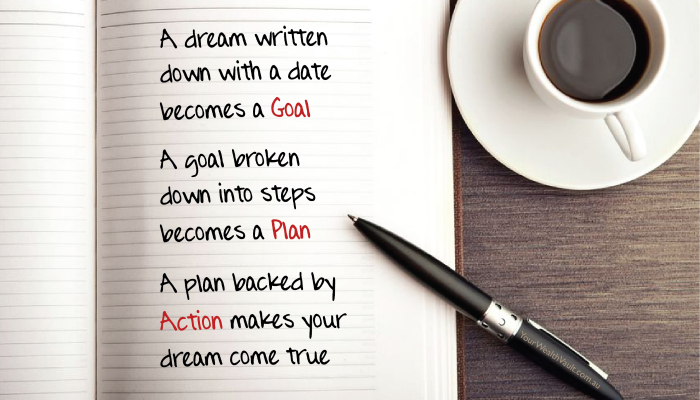
Dream your Goals

If you don’t know where you are it’s often hard to know where you are going. Establish a budget; then revise and review. Your budget is a living document, it keeps changing so you need to keep assessing and adapting to these changes. Put some realistic goals in place and try to stick to them. You’ll benefit in the long run. www.YourWealthVault.com.au

Tuesday, 21 June 2016

8 Really Important Things To Know When Starting Out


Whether you are starting your financial journey out of Uni, getting your first job, climbing the career ladder, jumping into a relationship, buying property or starting a business, you need to take control of your financial future. Here are 8 really important things to know when you are starting out.
One: Live without a credit card
Did you know that Australians owe approximately $32,673,480,146 in credit card debt as of this morning. Here’s an easier number: Thirty-Three Billion Dollars. Personal debt per credit card holder is $4301.00 with an average of $723.45 in interest per annum. Yikes!
For many of us refusing to use a credit card is simply not an option. Without one it’s difficult to pay bills and even make reoccurring payments. So use it for that and not for shopping. What should you use for shopping and spending I hear you murmur sarcastically? Use a debit card. You can’t spend more than you have in the bank that way. You’ll find you will spend less and when you next look at your bank statement you’ll even question what you are buying and maybe start to budget.
Two: You don’t have to keep up with the Joneses
Keeping up with your peers is dangerous. Just because they have the latest model of car or go on the holiday that you’ve always wanted to, doesn’t mean you should too. You don’t know what their situation is: they may have inherited some money, or they may be so far in debt that you don’t want to follow. You are you, they are they, don’t get confused with that. Live within your own financial means not your peers.
Three: Choose your partner very carefully
Business or personal partner, this is relevant to both. Don’t be impressed by a showy display of money or wealth, it may just be a façade and have a bucket load of debt supporting it. Be careful and be aware. When a business starts making money it’s very tempting, particularly if it is a new concept to your partner. There are so many horror stories of partners who get all consumed by newfound wealth and blow it all. Money can bring out greed in a person… very easily. Keep your finger on the pulse.
Four: Start Saving
More than 40% of a recent survey said they were able to meet their normal monthly expenses, but a third admitted they were worried about their ability to do so. The report said that the results clearly showed there are a large number of people who struggle to cope financially, and the problems are not always linked to the size of their pay-cheque. In many instances people are living in the hope that they will achieve their goals rather than planning for a fulfilling and secure future.
57% of those surveyed had no regular savings plan, and peaked among 45 to 54 year olds, who are often nearing the peak of their earnings capacity. Close to 40% of people would be unable to maintain their current lifestyle if they lost their income for three to six months, thanks to not enough savings.
So how do you counter that? Put a simple budget in place, as you never know when your financial situation can and will change. We like to call it Your Spending Plan as that is what we are all working around: Spending.
Five: Develop a budget
Don’t spend more than you earn. It’s hard to keep track of spending if you don’t have a budget. Putting a simple budget in place lets you know what you have to spend, and what you don’t. We like to call a budget a Spending Plan as that is what we are all working around: Spending.
Six: Get yourself health insurance
Without health insurance, you may not be able to afford expensive medical services when you need them but there are many more reasons why you need health insurance: Shorter waiting periods for elective surgery, choice of doctor, extras benefits to name a few.
You could end up paying more for private health insurance over your lifetime if you don’t take out hospital cover before 1 July following your 31st birthday. If you join after this time, you may be required to pay a 2% loading on top of your premium per year for every year you are aged over 30 and do not have private hospital cover, up to a maximum loading of 70%. For example, if you take out private hospital cover at age 45 you may pay 30% more than someone who took it out at age 30.
Do you really want to be significantly out of pocket when you are sick?
Seven: Keep track and set some goals
If you don’t know where you are it’s often hard to know where you are going. Hopefully you establish your budget, then revise and review. Your budget is a living document, it keeps changing so you need to keep assessing and adapting to these changes.
Put some realistic goals in place and try to stick to them. You’ll benefit in the long run.
Eight: Understand Superannuation
If you want enough money for a comfortable retirement, spend some time learning about superannuation. Taking a few steps now to boosting your Super will make a huge difference to your lifestyle in the future.
Superannuation is a way to save for your retirement. The money comes from contributions made into your super fund by your employer and, ideally, topped up by your own money. Sometimes the government will add to it through co-contributions and the low income super contribution.
Your employer must pay 9.5% of your salary into a super fund. This is called the Super Guarantee and it’s the law. The Super Guarantee will gradually increase to 12% in coming years.
Over the course of your working life, these contributions from your employer add up, or ‘accumulate’. Your super money is also invested by your super fund so it grows over time. When you retire, you will have money to live off – a nest egg. Super is a lifetime investment that has many benefits. Super can be a minefield of information so ask an expert for help, It’ll save you money in the long run.
So if you are starting out on the career path, in a budding relationship, a new business or “it’s just time”, get a grip on controlling your overall financial situation. Here’s a great Free e-book from Your Money Sense6-steps to Financial Security It’s a good starting point to get you in the right mindset when you are starting out.

Tuesday, 17 May 2016

And the Survey Says . . .  One in Five Aussies don't have enough savings.


An Ernst & Young survey of almost 5,000 people, commissioned by BT, found that 17% of people would struggle to find $500 to $1,000, while 30% had no money left over for savings.
It claimed that almost one in five Australians would struggle to come up with $1,000 to cover an emergency expense, while one in three people live from paycheck to paycheck, spending everything they earn, according to the survey.
More than 40% said they were able to meet their normal monthly expenses, but a third admitted they were worried about their ability to do so. At time of publishing the report it was said that the results clearly showed there are a large number of people who struggle to cope financially, and the problems are not always linked to the size of their pay-cheque. In many instances people are living in the hope that they will achieve their goals rather than planning for a fulfilling and secure future.
57% of those surveyed had no regular savings plan, and peaked among 45 to 54 year olds, who are often nearing the peak of their earnings capacity.
Close to 40% of people would be unable to maintain their current lifestyle if they lost their income for three to six months, thanks to not enough savings.
So how do you counter that?
Put a simple budget in place, as you never know when your financial situation can and will change. We like to call it Your Spending Plan as that is what we are all working around: Spending.
Here’s a helpful downloadable guide to control your spending and build your savings. 6-steps to Financial Security, a Free e-book from Your Money Sense. It’s a good starting point to get you in the right mindset to manage your money.

Tuesday, 10 May 2016

Are you a shoebox culprit?


So what is it? It’s the practice of throwing everything that might be important, like invoices and receipts, into a box and giving it to your accountant to sort out.

When someone refers to the “shoebox” in relation to your accounts or finances it means that the person has procrastinated doing their accounting by simply dumping the paperwork into a single place (better than scattered, but only barely) and deciding that they will address it at a later date, at which time it will likely be too late to fix any problems and bills which may be incorrectly billed for example. The implication is that the business suffers as a result because performance isn't being measured and problems aren't being addressed.

The other implication from the accountant's perspective, or even yourself if you are doing your own accounts, is the time to sort it all out can quadruple compared to being given all that information in order; say date order.

So how do you avoid becoming a shoebox culprit? You may enter your invoices and receipts into myob or xero yourself, or have a book keeper do it or hold it all for your accountant to do. Whatever your method is, a little foresight and time attention goes along way; both in time and cost. It’s as simple as buying a ring binder and hole punch. When you get a bill or receipt, punch it and stick it in the folder. Get into a routine of doing that every day or at least once a week. It will take discipline but will also save some serious headaches, and potentially financial losses, at tax time.

A good start to managing your financials is by downloading our Free Your Money Sense e-Book: “6-steps to Financial Security”.

So, are you a shoebox culprit?

Wednesday, 27 April 2016

Great money saving tip and could well be #1. What's your best tip?

Can you imagine spending $685 on groceries each and every week? Those of you with teenage boys certainly can. Yes, as scary as it sounds, that can be reality for big-boy big-families. Throw in a few packets of cereal, multiple litres of milk, a trolley of veges, half a trolley of meat and frozen dinners, topped up by lunchbox snacks and you’re well on the way.

Ok some of you may be thinking “That’s crazy money to spend each week”, others thinking “I wish it was only that.” Whatever you’re weekly grocery spend is, imagine if you could reduce it by 20%. In 5 weeks that’s a saving of 100% or 1 free shop every 6 weeks.
So what is the trick to this saving, and there is a trick? If we put this out to poll, and we will ask the question at the end, there would be many dollar saving ways to shop at your favourite supermarket. You could clip coupons from the local paper, although a lot of the shops have the actual catalogue on display before you walk in. How about creating a menu for the week so you are only buying essential ingredients? Or even create a standardised menu so you know what to eat and buy every week and not buying what you really don’t need. Too much time and effort? Yeah maybe, but good ideas to keep up your sleeve.
What is the trick then, the simple trick that can possibly save you up to 20% per week? Scale back the trolley size. That’s it! If you always grab the monstrous “just fit side by side down the aisle” size trolley, then grab the smaller “I may need to stack it a little higher” size trolley. Or if you can, just grab the hand held basket for the essentials. If you have a helper with you, it’s ok to carry one each or even two each. You may have to distribute the weights evenly throughout the baskets but it is possible to do. Those of you with the big-boy big-families could try one trolley and a basket, instead of two trolleys.
Don’t brush this valuable grocery money saving tip off lightly, think about it, as it is practical and will save you money. Shopping using the ‘smaller bucket load’ method will take a little planning once you’re in the shop but it encourages you to only get what you need, not all those “I have room for that and the shelf position and marketing is good so I’ll get it” items. Try it a couple of times and see how it works for you.
For more tips on saving money and budgeting please download our Free eBook: 6 Steps to Financial Security.
What is your grocery shopping money saving tip?

Tuesday, 12 April 2016

Is Money an Anxiety Trigger for you?


Anxiety is a serious issue with about 12% of the population suffering from this debilitating condition. That in itself is alarming. Anxiety sufferers struggle to learn how to cope with the many day-to-day triggers in their lives. It’s a great challenge for many of them. These triggers can come from anywhere, but one big trigger for independent adults is money. “Do I have enough, should I buy that, I’ve just spent too much, which bill shouldn’t I pay this month, have I actually saved any money this month?” Even for those that do not ‘technically’ suffer from anxiety, these questions can still raise their ugly head.
So how can you learn to cope with your money? To do so you need to organise your money and realise that putting a system in place will clearly show you what’s happening to your money. Is it coming in or is it going out? To simplify it, your money is pretty much a bunch of numbers, some positive and some negative. So to exist, you need to have a positive number at the end of the month.
OK, so how do you get to this positive number at the end of the month? Having a system of recording with regular checking will show you the flow of your money. It’s called a cash-flow. If you’ve got $100 coming in and $110 going out, then you are $10 cash-flow negative. To turn this around you need to stop spending at $100, or even better, at $90 so you’re now $10 cash-flow positive. How does one stop spending? By tracking where your money is going; watching your cash-flow. If you note and track your cash-flow each month you will soon see a trend of what’s happening and only then be in a position to work out how to change that.
Simplistically put: Record your money-in and money-out, review what’s happening to your cash-flow, and spend less than you make. That really is the mountain top view but it’s a good start to becoming more comfortable with, and less fearful of your money.
By managing the flow of your money you are in control and to an anxiety sufferer, control is a godsend.
A good start to this process is by downloading our Free Your Money Sense e-Book: “6-steps to Financial Security”.
x